
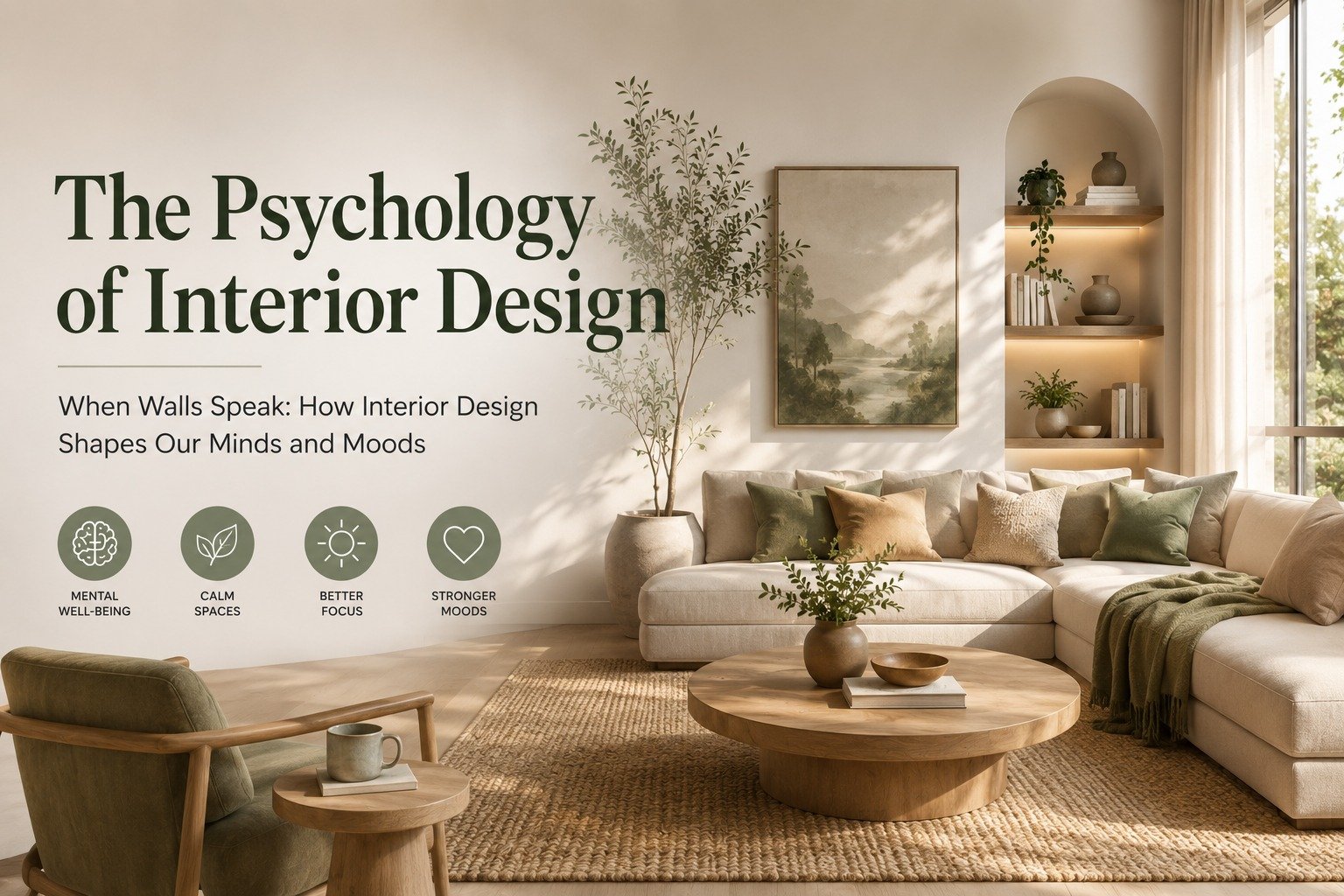
Imagine walking into your home after a long, tiring day. The room is filled with soft lighting, warm colors, and a peaceful atmosphere. Within moments, you feel calmer. Now imagine entering a space with harsh lighting, dull gray walls, and clutter everywhere. It instantly feels stressful and uncomfortable.
That’s the power of interior design. The spaces we live and work in affect how we think, feel, and even perform. From colors and lighting to textures and layouts, every design choice can influence our mood, focus, and overall well-being.
In this blog, we’ll explore the psychology of interior design and discover how thoughtful spaces can reduce stress, improve productivity, and create a greater sense of comfort using simple, practical design principles
Have you ever walked into a room and instantly felt relaxed without knowing why? Or stepped into a space that made you feel uncomfortable within seconds? That’s not just a feeling—it’s psychology.
The spaces around us have a real impact on our emotions. Things like colors, lighting, layout, and materials quietly shape how we feel throughout the day.
Imagine sitting in a hospital waiting room filled with natural light, wooden finishes, and a few indoor plants. It feels calmer and more welcoming than a room with harsh fluorescent lights and plain gray walls. Research shows that adding natural elements—like sunlight, greenery, and wood—can reduce stress and improve our mood.
Our brains are naturally drawn to spaces that feel safe, warm, and connected to nature. That’s why thoughtful interior design isn’t just about making a space look beautiful—it’s about creating places where people genuinely feel better.
Have you ever wondered why spending time in nature instantly makes you feel calmer? The answer lies in the way our brains respond to natural environments. Humans have evolved alongside nature for thousands of years, so our minds instinctively react positively to sunlight, greenery, natural textures, and organic patterns.
Research in neuroscience suggests that exposure to natural elements can help reduce stress, improve mood, and support better cognitive performance. Simple features like wooden surfaces, leafy plants, or views of greenery create a sense of comfort that many modern interiors often lack. Materials such as wood and stone not only add visual warmth but also encourage a stronger connection to the natural world.
Natural daylight plays an equally important role. Bright, well-lit interiors help regulate our body’s internal clock, improve focus, and create healthier living and working environments. When combined with plants and organic materials, these elements create spaces that feel welcoming, balanced, and restorative.
Studies have also found that nature-inspired environments can benefit healthcare, education, and workplaces by supporting emotional well-being and improving the overall user experience.
Whether it’s a home, office, or commercial space, incorporating natural elements creates interiors that feel healthier and more enjoyable to spend time in.
If walls could talk, their colors would speak volumes. Color is a silent language that our brains understand deeply – long before we have words for it. Neuroscience shows that our eyes register color and trigger brain responses within seconds. In workspaces and homes, choosing the right palette can make a measurable difference in focus, energy, and creativity. For example, an eye-opening study found that workers in totally white or gray offices felt 25% sadder and 30% less energetic than those in color-rich environments. In fact, simply adding vibrant yet thoughtful color schemes improved both mood and productivity significantly.
So which colors work best for different goals? Research-backed guidelines suggest:
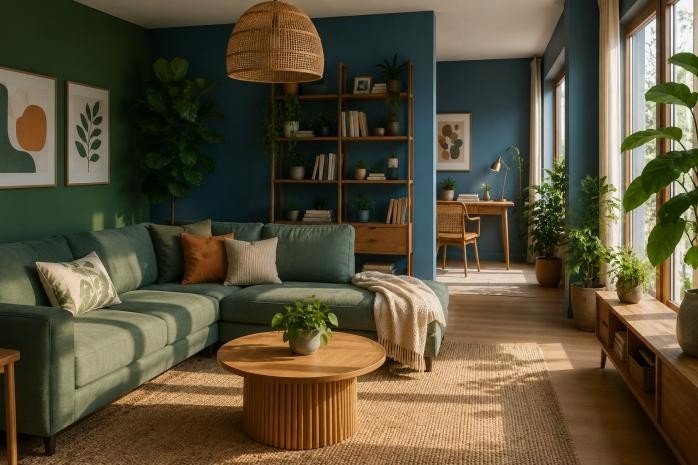
As RMCAD’s design guide puts it, “Colors speak a silent language we all understand”. Warm tones (reds, oranges, yellows) can invite comfort and conversation, while cool tones (blues, greens) promote tranquility and concentration. The mood you choose for a room – be it energetic, calm, or cozy – should guide your color choices. Thoughtful color psychology ensures that every hue in the room supports what you want people to feel and do there, often unconsciously.
Some spaces instantly feel like a sanctuary. Why does a cozy reading nook or a zen meditation room put us at ease? It often comes down to three “P”s of peaceful design: Presence of nature, Pleasant light, and Proportional balance.
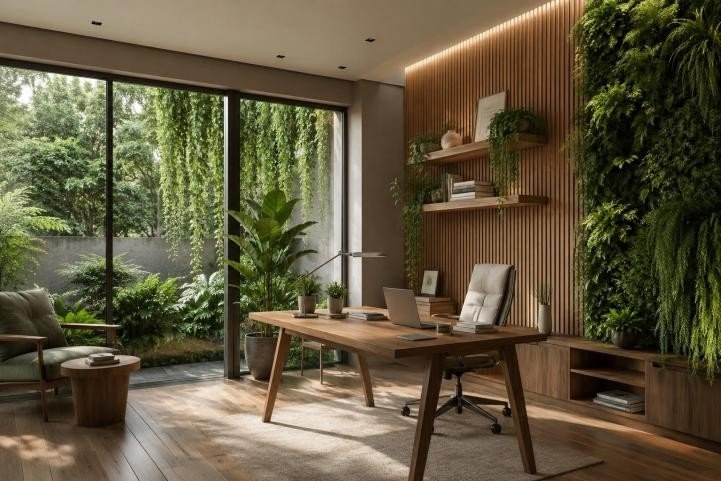
scientifically proven calming effect. Biophilic design, which connects us to nature, “enhances the well-being of occupants” by grounding them in natural patterns. Imagine a home office with a view of a garden, a living wall of plants, or wood veneer on the walls. These elements reduce fight-or-flight stress responses. Studies of people in indoor spaces confirm that a view of trees and sunlight reduces stress and improves mental comfort. Even potted plants near your desk
boost creativity and air quality, subconsciously signaling to your brain that you’re in a healthy, nurturing environment.
whereas softer light “keeps them steady”. Designers often use a mix: bright task lights where needed, plus warm ambient lamps and shaded pendants to balance the mood. The result is a space that feels alive but not overstimulating.
Finally, soft, curved edges everywhere create subconscious comfort. As the Bond University study noted, round rooms made people feel “calmer” and more creative. A winding hallway or an arched doorway signals safety, whereas a barrage of sharp corners may subconsciously put us on alert. That’s why even in modern design, elements like circular rugs, arched windows, or oval tables are popular: they feel more organic and welcoming.
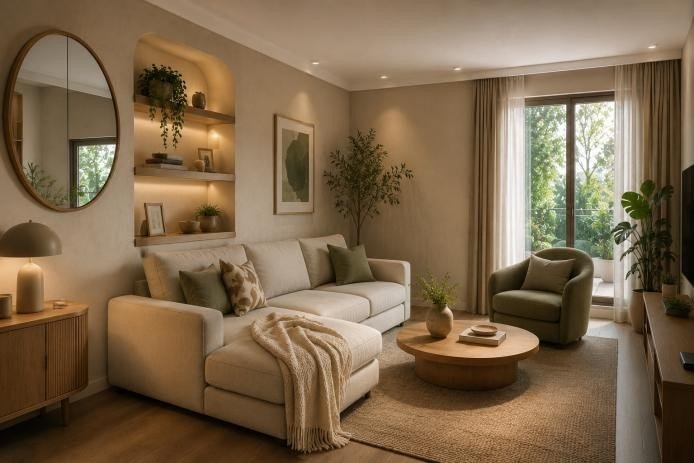
By combining these elements, a space feels harmonious. For instance, a bedroom with earth-tone paint, flowing drapes, a view of trees, and a bed framed in natural wood can evoke the soothing feel of being outdoors. Public spaces can also leverage tranquility – a hospital lobby with water features and plantings helps patients relax, while a co-working café with bright windows and open layout can quietly energize visitors.
Behind the scenes, our brains are hardwired to react to design, even before we’re conscious of it. This is the realm of neuroaesthetics – the study of how our brain responds to beauty and architecture. At a basic level, the brain processes color, light, and shape the moment we enter a room. Within a second, neural circuits in the visual cortex are firing, linking to emotional centers like the amygdala. For example, as one design psychologist puts it, “the brain can smell” the presence of natural wood even without a scent: just seeing wood triggers memory and relaxation.
Experts like Dr. Anjan Chatterjee have identified principles that our brains use to judge
spaces: coherence (how everything fits together), fascination (visual interest), and hominess (sense of comfort and familiarity). A room that scores high on these often feels immediately “right”. If it’s coherent (colors and textures that belong together), fascinating (something beautiful or novel to look at, like artwork or a plant wall), and homely (not too alien or chaotic), our parasympathetic nervous system leans towards calm.
Neurologically, many studies find consistent responses: symmetry and order activate calm pathways, while chaotic arrangements spark stress signals. Smooth, natural textures and curves give soothing feedback to our touch and sight, releasing brain chemicals that lower anxiety. Even
adaptive lighting – lights that mimic natural daylight cycles – have been shown to keep cortisol levels balanced across the day.
One example: material choice. Touching cool steel versus warm wood can produce different pulses in the brain’s reward circuits. HOK interior experts note that seeing natural materials like wood or stone actually drops our heart rate. Similarly, exposure to greenery activates areas of the brain associated with pleasure and relaxation, as some fMRI studies suggest.
Importantly, this neural wiring doesn’t just affect mood; it also affects performance. Workers in well-designed spaces – with natural light, plants, pleasing colors – report higher focus and better problem-solving. Designers have moved from relying on gut feeling to using real neuroscience data. For instance, an office with biophilic elements doesn’t just look nicer; wearable sensors show employees in such offices have lower blood pressure and smoother heart rhythms after a stressful meeting.
All of this means that beautiful, human-centered design is not frivolous. It’s built on the understanding that our environment literally shapes our thoughts and feelings. By honoring the brain’s preferences – such as its love for nature, balance, and gentle stimulation – architects and designers make spaces work better for us. The field is so compelling that firms are holding workshops on “neuroaesthetic design” to train teams on these principles.
As we’ve seen, the science of interior psychology shows that what you build is how you feel. Thoughtful design is a form of caring for the people who use a space. For homeowners, it means that something as simple as repainting a room, adding a few plants, or rearranging furniture can have measurable benefits for your mood and mental health. For businesses, investing in good design can boost employee well-being and productivity (and yes, that often means better profits). Even if you’re just setting up a dorm room or work-from-home corner, understanding these principles can help you create a personal haven.
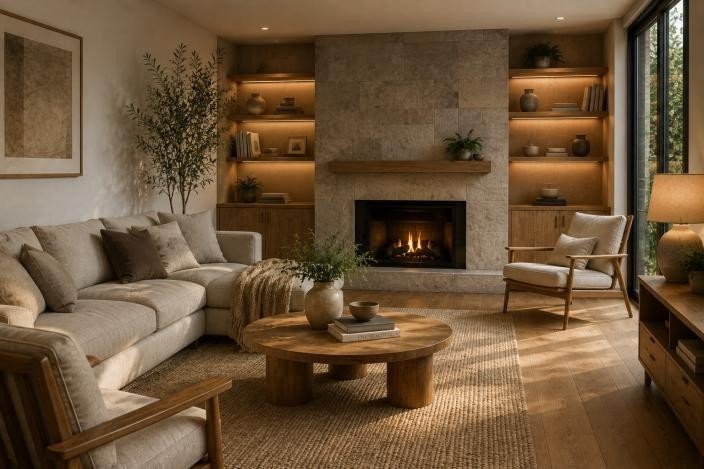
By applying just a few evidence-backed tweaks, any space can become more than just functional – it can be nurturing. In the end, great interior design is less about decorating and more about
telling a story of comfort, energy, or rest, depending on what the moment calls for. It’s about turning walls into silent allies of our well-being.
You don’t need a major renovation to enjoy the benefits of biophilic design. Simple changes can make your home or workplace feel healthier, brighter, and more connected to nature.
Start by adding indoor plants such as snake plants, pothos, or peace lilies. They introduce greenery, improve the atmosphere, and bring life to any room. Next, maximize natural light by keeping windows unobstructed and using light-colored curtains to allow sunlight to flow through the space.
Choose natural materials like wood, stone, bamboo, rattan, or linen for furniture and décor. These textures create warmth and add a timeless, organic feel. You can also introduce earth-inspired colors such as sage green, terracotta, beige, or warm brown to create a calm and welcoming environment.
Small additions like a tabletop fountain, nature-inspired artwork, or a cozy reading corner beside a window can further strengthen your connection with nature. As your project grows, consider larger features such as skylights, living walls, or indoor gardens. Consulting an experienced interior designer can help you incorporate these elements while maintaining both style and functionality.
We spend up to 90% of our lives indoors, so it matters deeply how those interiors make us feel. Good design acknowledges that our homes and workplaces are not just backdrops but active ingredients in our mental health. By weaving together color psychology, thoughtful layouts, and natural elements, designers create “healing spaces” that can uplift or calm us at the right times. Whether you’re a homeowner looking to refresh your living room, a student designing a dorm room, or a professional planning an office, remember: every design choice – from the color on the wall to the curve of a doorway – has the potential to heal, inspire, and energize the human mind.
Interior design isn’t just art – it’s architecture for the soul. And as the research shows, a beautiful, well-crafted space really can soothe our spirits.
Sources: Cited research and expert insights from interior design and neuroscience (Marymount
U. architecture blog, Kyung Hee University study on healing spaces, Bond University’s space psychology research, HOK’s neuroaesthetics panel, MODULYSS design science, and others on color and biophilia). These show how design influences emotion, productivity, and well-being
Shipping & taxes calculated at checkout
Proceed to Checkout → View CartTell us about your project and we’ll create a personalized proposal